
Time To Win
Erik D. Prince on Fiat Experts: How the Priesthood of Failure cost America $38 Trillion of Administrative Bloat

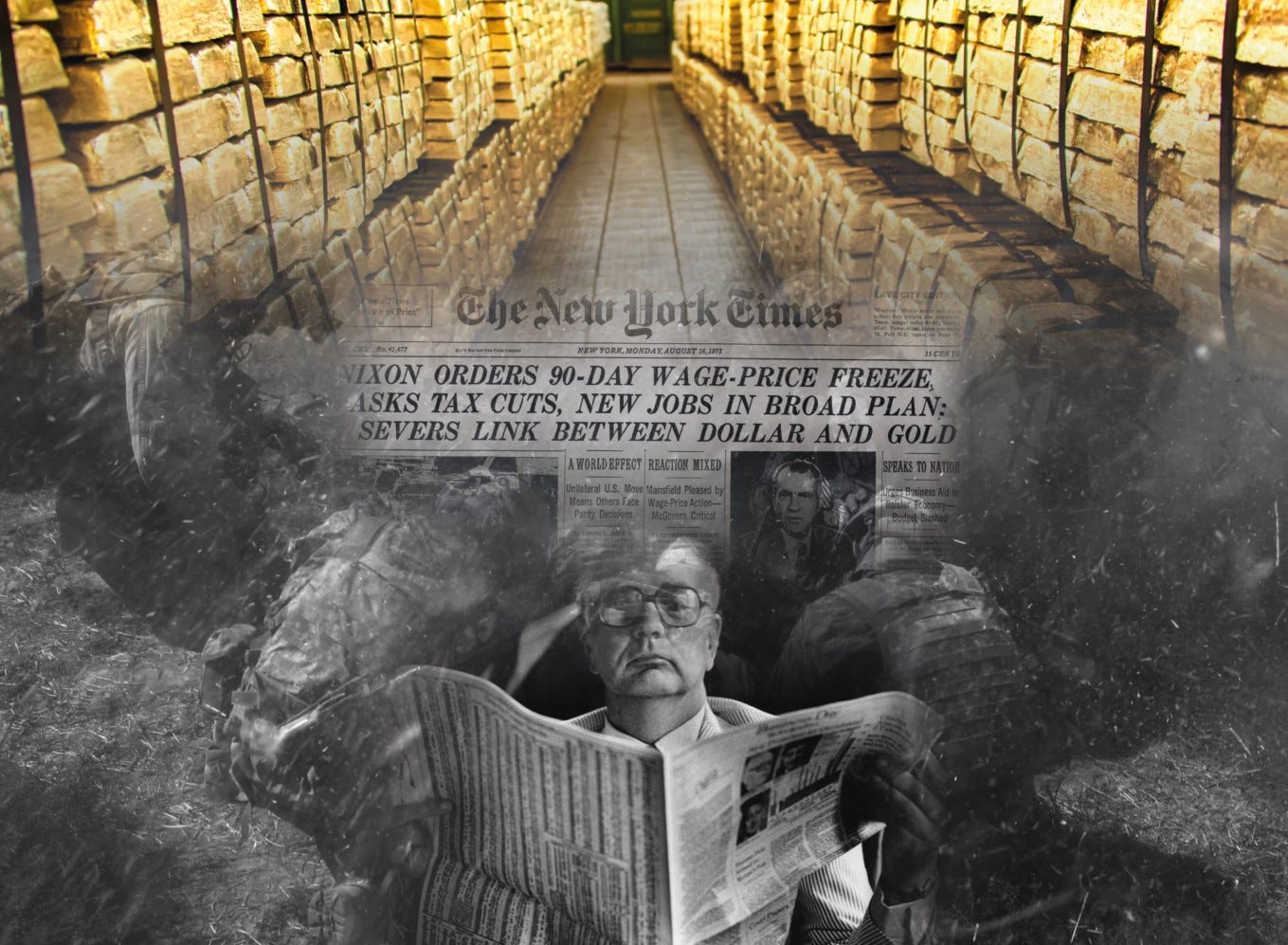
The COVID pandemic provided a natural experiment in experts’ competence. The results were unambiguous. Every major government recommendation was proven wrong: masks did not work, then they were essential, then two were better than one. The virus did not spread asymptotically; then, asymptomatic spread became the primary driver. Two weeks to flatten the curve became two years of flattening.
The curve remained unimpressed. Models predicted tens of millions of deaths in the immediate near-term, though the natural case fatality rate proved to be a fraction of those initial dire estimates. Much of the death toll ended up as an outcome of the public health establishment’s recommendations: their warnings to stay indoors to avoid getting sick, their war on doctors promoting early self-treatment at home, and their encouragement of the widespread use of ventilators, which caused tremendous harm.
The models were wrong about the baseline, the intervention, and the outcome, despite being ‘peer-reviewed’ (another word for ‘immune to reality’).
When the interventions failed, America’s 80,000 health bureaucrats did not resign in disgrace or apologize. The CDC requested larger budgets. The FDA approved more emergency authorizations. Several officials were promoted, while parents who questioned school closures at board meetings were investigated as potential domestic terrorists. How did Anthony Fauci—whose record on AIDS, swine flu, and COVID was at best uneven—end up the highest-paid federal employee and a media celebrity? Why does failure never disqualify these experts?
The answer lies on August 15, 1971, when President Richard Nixon appeared on television. President Nixon announced a temporary suspension of the convertibility of the dollar into gold, which would then become permanent. This decision removed the last constraint on money creation. Between 1971 and 2024, the Fed’s balance sheet expanded from $80 billion to over $8 trillion—a hundredfold increase —causing not only inflation in goods and services but also in expertise.
Thus, a new species of bureaucrat was born: the fiat expert.
The Priesthood
Before 1971, the gold standard imposed discipline. The government could only spend what it taxed or borrowed from real savings. This natural limit constrained the number of expert bureaucrats a society could support. But after 1971, the Federal Reserve could create unlimited (fiat) dollars. These fiat dollars created positions, which in turn created fiat experts, who in turn created policies that destroyed businesses, lost wars, and locked down the country.
This is how it works: the Federal Reserve prints money. The money funds universities that grant credentials. The credentials qualify people for government positions. The positions grant authority over people who actually know how to do things.
A 23,000-person Federal Reserve—our central bank (“the Fed”)—sets interest rates for every farmer, manufacturer, and business owner in America. But few among them have ever grown food, made products, or met a payroll. The distinction between office space and field space explains why some people face no consequences for catastrophic failure, while others face consequences for even minor mistakes.
Farmers, carpenters, plumbers, and soldiers operate in field space where physics, mathematics, biology, and bullets provide immediate feedback on the quality of decisions. Fiat experts, like fiat currency, derive their value from government decree rather than demonstrated competence. They proliferate in office spaces where bureaucrats, think tank fellows, and college academics write reports about reality without ever witnessing it.
The institutional decay is starkly visible across elite American education. In 1970, American universities granted roughly 1,000 doctoral degrees in sociology annually. By 2020, that number had quintupled, bearing no equivalent result. When was the last significant sociological discovery? This expansion affected virtually every major U.S. research institution, including Ivy League institutions, which recorded a massive increase in non-STEM doctoral programs and administrative roles since 1971.
But just as printing money devalues currency, printing credentials devalues expertise. The influx of fiat funding and the pursuit of fiat expertise have driven up costs, inflated credentials, and shifted the universities’ focus from teaching students and producing foundational research to managing compliance and churning out more administrators.
The more credentials America’s top universities dispense, the less meaningful the actual education becomes. Today, an Ivy League degree costs roughly $95,000 annually, subsidized by government loans the Fed happily monetizes. The result? More courses that teach students about gender theory, encourage statue-toppling as civic engagement, while canceling professors for supporting free speech.
The professional class bloat extends directly to the “ideas industry.” Liberal and conservative think tanks multiplied dramatically over the decades. In 1970, D.C. hosted two dozen policy institutes. By 2020, over 400 organizations will compete to influence policy, funding a vast intellectual infrastructure, each employing hundreds of people solely to produce thousands of dense policy proposal papers every year. For what? Has this translated into effective governance? Can anyone name how a single one of these policy papers improved the country?
Federal agencies followed the same trajectory. The Department of War (formerly Defense) provides a glaring analogy. The military’s active-duty fighting force has shrunk dramatically since the Cold War. In 1971, the U.S. had about 2.7 million active-duty personnel. Today, that number is roughly 1.3 million—a cut of more than half. Yet, the administrative overhead has soared. In the early 1970s, the DoD employed approximately 1 million civilian personnel. Today, the total administrative workforce (federal civilians plus full-time equivalent contractors) stands at approximately 1.32 million (760,000 civilians + 560,000 contractors).
This means the Department of War now funds more administrators and bureaucrats than active-duty soldiers, sailors, airmen, and marines—comprising a massive, expensive bureaucracy that is slower, more complex, and less efficient than the system it replaced.
It gets worse. The Department of Education (ED), created in 1979, now employs over 4,000 people. The ED’s mission is to promote excellence and equal access. But national academic data (NAEP) shows a negative trend. Student scores have largely stagnated for decades, with recent data indicating sharp declines. Math standards and reading comprehension have both deteriorated. It seems the more education bureaucrats America employs, the less educated Americans become.
The bureaucrats create policies that prevent education while expanding their own ranks. Does America really need a Department of Education? How did Americans get educated before 1979?
The Environmental Protection Agency (EPA) has grown from 5,000 employees in 1970 to over 17,000 today. During this period, it produced 30,000 pages of regulations. Yet these regulations failed to prevent Love Canal, the Exxon Valdez spill, the Deepwater Horizon disaster, the Flint water crisis, or the East Palestine chemical derailment. Not only did they fail, but each failure justified more employees, more regulations, more failure.
The cycle is not accidental. It is the business model.
The Federal Reserve itself represents peak fiat expertise. Today, 23,000 employees set the price of money for 342 million Americans, manipulating interest rates that determine whether families can afford homes, whether businesses can expand, and whether retirees can live on savings. Yet again, not one of these people has ever operated a company or met a payroll. These credentialed bureaucrats are the economic equivalent of celibate marriage counselors: technically qualified, practically clueless.
The Fiat experts share defining characteristics: they work in climate-controlled offices (as opposed to farms, factories, or battlefields). They produce papers (as opposed to products). They attend conferences (as opposed to customer meetings). Most importantly, they face ‘peer review’—rather than profit and loss statements. When their recommendations fail, they recommend more recommendations. When their models are proven wrong, they build more complex models. When reality contradicts their theories, they conclude reality is flawed.
The most telling characteristic is that Fiat experts are never fired for being wrong. A farmer who cannot grow food goes hungry. A manufacturer that cannot satisfy customers goes bankrupt. A soldier who cannot fight effectively goes home in a box. But a fiat expert who recommends policies that destroy farms, bankrupt manufacturers, and lose wars? He receives tenure, grants, and speaking fees.
In field space, failure has consequences. In office space, failure has rewards.

Field Space vs. Office Space
When protests in the wake of George Floyd’s death filled the streets, the same experts who had ordered small businesses closed and family restaurants locked down suddenly declared mass gatherings safe (as if the virus respected the righteousness of the cause).
The lockdowns created two categories of humans: essential and non-essential. Essential meant government employees, healthcare workers, and employees of large corporations in office spaces. Non-essential meant small business owners, independent contractors, and anyone who worked with their hands in the field. The economic consequences of the bureaucratic Office Space were immediate and devastating for Field Space America.
Consider the case of Karl Manke, a 77-year-old barber in Owosso, Michigan, who became a national symbol of resistance. Manke defied the state’s lockdown by simply going to work. His income, like that of all small business owners, stopped instantly when the lockdown mandate arrived. Unlike government employees who continued drawing salaries while “working” from home, Manke had to choose between his license and feeding himself.
The Office Space response was immediate and overwhelming. The Michigan Attorney General and health departments issued misdemeanor citations, ordered his shop closed, and summarily suspended his barber license. This bureaucratic use of paper power—the fiat license—was deployed to crush a physical livelihood. The enforcement officers—the lawyers and the judges who signed the orders—all retained their full salary and benefits, whereas Manke was deemed ‘non-essential’.
Meanwhile, a few miles away from every shuttered small retailer, a Target store remained open. It sold groceries, which made it ‘essential’. It also sold clothing, electronics, home goods, and everything else Manke’s neighbors might have purchased from small businesses. Amazon’s revenue increased by 200 billion dollars during the pandemic. Jeff Bezos’s net worth increased by $70 billion. Every small retail business forced to close transferred its customers to large corporations permitted to operate.
Was this a public health measure, or a deliberate wealth transfer, powered by bureaucratic decree?
The California Restaurant Association’s legal challenge against Governor Newsom’s mandates magnified this. The stroke of a regulatory pen wiped out thousands of field-space businesses. One example is Alioto’s on San Francisco’s Fisherman’s Wharf, a family-owned restaurant that had served its community since 1925 before the mandates forced its temporary closure in March 2020. It officially closed its lease in April 2022, after 97 years.
San Francisco’s own health department later reported that restaurants accounted for less than 2 percent of COVID-19 transmission. The vast majority occurred in private homes and institutional settings. A professional kitchen, with its commercial ventilation and professional sanitation, was infinitely safer than the private gatherings that replaced it. But safety was never the point. Control was. The fiat experts dictated the terms of survival from their office space, eradicating decades of field space enterprise with zero accountability for the devastation.
According to Federal Reserve data, the top 1 percent gained approximately $6.5 trillion in wealth during the pandemic, while the bottom half saw their already negligible share of total wealth evaporate under inflationary pressure. This was not a pandemic outcome. This was a policy outcome structurally guaranteed by fiat experts who faced no economic or criminal consequences for the savings and income theft they wrought on real experts.
The pattern holds across domains. What you learn when you operate in hostile environments such as Mogadishu, Baghdad, or Kabul is that plans that work on PowerPoint slides often fail in practice. You learn that the sixteen-step approval process developed by lawyers in Northern Virginia becomes irrelevant when armed militants attack a convoy, and that theoretical expertise divorced from operational experience produces catastrophic decisions.
Outside the office, you learn the difference between mistakes that translate into revised reports and mistakes that translate into coffins. I (Erik Prince) have spent three decades in field space across four continents: Afghanistan during the Taliban insurgency, Iraq during the civil war, Somalia, South Africa, and other environments. In all of these places, theoretical expertise meant nothing. There is no peer review process for an ambush. There is no tenure protection from an Improvised Explosive Device (IED).
In the real world, either your decisions work, or people die.
Wars Without Victory
The Global War on Terror (GWOT) provides another case study in fiat expertise. Between 2001 and 2021, the United States spent over 8 trillion dollars on wars in Afghanistan, Iraq, Syria, Libya, and associated conflicts. For context, 8 trillion dollars could have rebuilt America’s entire infrastructure twice, provided free college education for every American for a century, or even ended homelessness permanently.
Instead, it brought failure.
In Afghanistan, the stated goal was to deny safe haven to terrorists. Yet after twenty years and 2.3 trillion dollars spent, the Taliban is back in power and controls more territory than it did on September 11, 2001. Al-Qaeda has reconstituted. ISIS K has emerged. The terrorist threat is worse, not better. Every metric of success moved in the wrong direction. Girls who attended school during the American occupation now sit at home. Women who once worked cannot leave their homes without male escorts. Allies who assisted American forces now hide from retribution or lie dead in unmarked graves.

The Afghanistan Papers revealed that senior officials knew the war was unwinnable for years. They lied to Congress. They lied to the public. They lied to the soldiers they sent to die. General after general testified about progress that did not exist. Districts marked as under government control existed only on maps in air-conditioned offices. On the ground, the Taliban collected taxes and enforced law.
Having operated in Afghanistan, I can attest to the delusion. A military briefing would show a district in green, indicating it is under government control. On patrol in that same district, we would encounter Taliban checkpoints. The disconnect between PowerPoint and patrol was absolute. But which version made it back to Washington, determined funding, or shaped policy?
The Hindu Kush mountains perfectly encapsulate the futility. For twenty years, American soldiers patrolled valleys that Alexander the Great could not conquer, that the British Empire could not hold, and that the Soviet Union could not pacify. But did anyone at the State Department or the Department of Defense read a history book by someone who has countered an actual insurgency, or were they too busy attending conferences on ‘insurgency theory’?
When Kabul fell in August 2021, the collapse was so rapid that Americans and allies were abandoned. Tens of billions in military equipment were left behind. The Taliban now operates American helicopters, drives American vehicles, and carries American weapons.
The humiliation was complete.
Which general was fired for this catastrophe? None. Which defense official was prosecuted for lying to Congress? None. Which think tank expert who advocated for continued occupation admitted error? Why did General Milley stay as Chairman after Kabul fell? Why did Lloyd Austin keep the Pentagon after leaving Americans and allies behind? Why did Antony Blinken remain Secretary of State when the diplomatic ledger showed only red ink from Kabul to Kyiv?
The architects of strategic failure retained their corner offices. Meanwhile, junior officers who executed their orders faced investigation. Enlisted personnel who conducted the evacuation faced criticism. The accountability flowed downward, never upward. In the fiat expert system, rank protects from responsibility.
Iraq tells a similar story. The invasion was justified by weapons of mass destruction that did not exist. The experts who claimed certainty about WMDs faced no consequences when proven wrong. The war cost over 2 trillion dollars and killed over 4,500 American troops and thousands more contractors. Suicides among returning veterans skyrocketed. It destabilized the entire Middle East, created ISIS, and strengthened Iran. How did Paul Wolfowitz, who promised Iraqis would greet Americans as liberators and said that Iraqi oil would fund the invasion, move on to the presidency of the World Bank? Why did Dick Cheney, who helped orchestrate the invasion, retire to wealth and comfort and face no accountability?
The pattern holds across every intervention: experts with no military experience design wars. Think tank fellows who have never heard a shot fired in anger advocate for others to fight—generals who have never won a war plan the next one. Intelligence officials who missed 9/11, missed ISIS, missed the Taliban resurgence, lecture about threats. The failure is systematic because the system selects for failure. Success would end the wars. Ending the wars would end the funding. Ending the funding would end their careers. So the wars continue, and the failures compound.
Once again, having operated in these environments, I witnessed alternative approaches that could have succeeded: local solutions that would have cost a fraction of the trillions spent, and empowering tribal structures that actually functioned, rather than imposing democratic frameworks that existed only in think-tank fantasies.
These were rejected. They did not route funding through Beltway contractors or provide jobs for State Department bureaucrats, so the Pentagon preferred spending tens of billions of dollars in failure rather than circumventing the established system and possibly succeeding.

The Health Bureaucracy
The same engine of fiat money powers the entire health bureaucracy and serves the same class of fiat experts.
America’s federal health agencies employ approximately 80,000 bureaucrats. These agencies include the CDC, FDA, NIH, and various other acronyms that proliferate rapidly. Under their expert guidance, America has achieved a remarkable feat. The nation represents roughly 4% of the world’s population but accounts for approximately 45% of global pharmaceutical sales. This is not a typo. Four percent of people. Forty-five percent of prescription drug revenue.
Americans consume more antidepressants, more opioids, more diabetes medications, more statins, more hypertensives, and more anti-anxiety medications than any other population in human history. This raises a crucial question about the physical authority of this class. How many of these 80,000 health bureaucrats can run a single mile without stopping? How many can do a single pull-up or properly deadlift their own body weight? How many are themselves on multiple prescription medications? The experts advising America on wellness often embody the very lack of health they claim to combat.
The same agencies that oversaw this transformation into pharmaceutical dependency promised that more pharmaceutical intervention was the solution to COVID. Reports indicate that NIH-funded Gain-of-Function research at the Wuhan Institute of Virology was conducted through EcoHealth Alliance. But when questioned about this under oath, officials did not provide clear answers; instead, they parsed words like lawyers.
The revolving door between health agencies and pharmaceutical companies spins rapidly.
Scott Gottlieb left the FDA in 2019 and joined Pfizer’s board that same year. During the pandemic, he appeared regularly on television as a medical expert, yet the news chyrons never disclosed his Pfizer affiliation. Why did Gottlieb, fresh from running the FDA, walk straight onto Pfizer’s board and then onto cable news sets as an “independent” medical voice? Did the revolving door just happen to spin in his favor?
Former CDC directors routinely join pharmaceutical companies or consulting firms serving pharmaceutical clients. This is public service conducted from office space, where conflicts of interest are managed through disclosure forms rather than avoided through separation.
CONTINUE READING AT: IM1776.COM
Erik D. Prince is a former Navy SEAL officer and the founder of private military company Blackwater. Among his current projects is the Unplugged phone, a privacy-focused smartphone. He can be followed @realErikDPrince.
Dave Ramaswamy is an independent commentator on geopolitics and strategic affairs.
Shipping Now

Well stated summary of money first corruption and fraud at the top, with negative consequences downstream always. Figuratively 10% for the big guys and f@ck everyone else about sums it up.
Why did you stop updating your substack?
Upd: oh ok no website updates as well